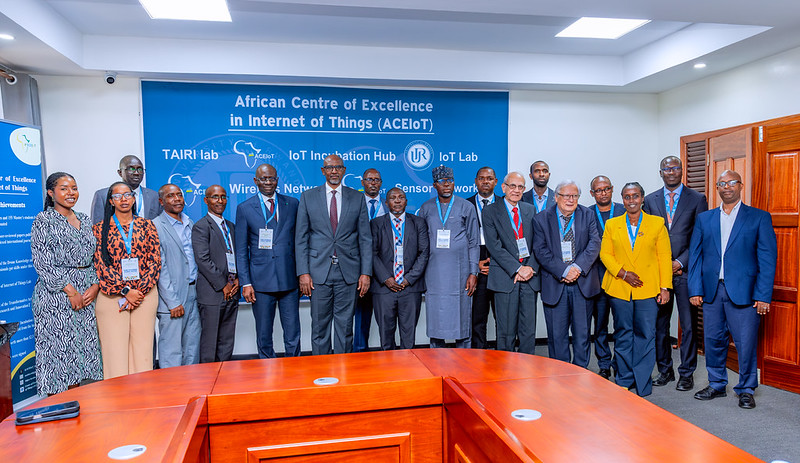
Members of the Governing Council of the Partnership for Skills in Applied Sciences, Engineering and Technology (PASET) Regional Scholarship and Innovation Fund (RSIF) on 8th October 2026 visited the University of Rwanda, College of Science and Technology at African Centre of Excellence in Internet of Things (ACEIoT), one of the RSIF host university where they commended the Centre’s progress in research, innovation, and postgraduate training.
The visit followed the conclusion of the PASET Governing Council meeting in Kigali and provided an opportunity to showcase the impact of the scholarship programme, highlight the University of Rwanda’s achievements as a host university, and explore the strategic role of African universities in advancing science, technology, and innovation.
The delegation was led by Rwanda’s Minister of Education and Chair of the PASET Governing Council, Hon. Joseph Nsengimana, accompanied by Senegal’s Minister of Education, Hon. Dr. Boubacar CAMARA, Prof. Goolam Mohamedbhai, Chair of the PASET Consultative Advisory Group (CAG) and other representatives from Nigeria, Tanzania, and Mozambique, Dr. Mutimura Eugene, Executive Secretary, National Council for Science and Technology (NCST), Dr Sylvie Mucyo, Vice Chancellor for Rwanda Polytechnic(RP) and many others.
In his welcome remarks, the Vice-Chancellor of the University of Rwanda, Prof. Kayihura Muganga Didace, expressed appreciation to PASET for selecting the University to host scholars under the RSIF programme. He highlighted the programme’s contribution to strengthening research capacity and developing highly skilled researchers across Africa.
Since 2020, six cohorts comprising 23 PhD students from 11 African countries have joined the programme at the University of Rwanda and 7 of them have graduated and 4 are to graduate in October . The scholars represent Rwanda, Ghana, Zimbabwe, Burundi, Uganda, Tanzania, Nigeria, Cameroon, Mozambique, Mali, and Kenya.
“We are proud that this is a truly pan-African community, and that we are learning from each of these countries as much as we are teaching. The results are visible. Seven scholars have graduated, and alumni are already putting their training to work,” Prof. Kayihura said.
He also highlighted the international exchange programme as a distinctive feature of the PASET model. Through this initiative, scholars spend between six and twelve months at an International Partner Institution (IPI), gaining access to advanced research infrastructure, specialised resources, and international expertise that complement the training and facilities available at their home institutions and this has expanded UR partnership with 9 International Universities. .
These opportunities help strengthen research capacity, foster international collaboration, and equip African researchers to contribute to scientific advancement and address development challenges across the continent.
The Principal of the College of Science and Technology, Prof. Ignace Gatare, highlighted key achievements at ACEIoT and the University of Rwanda from RSIF funds that contribute to the quality and international competitiveness of postgraduate education and research.
Among the achievements highlighted from 11 RSIF funded projects and offered to UR faculty and students, include the enrollment of 23 PhD scholars (where 7 have graduated and 10 are employed), development of 9 prototypes, IP registration, training of 270 people in the use of those prototypes, 21 publications and 13 partnerships, which strengthens the visibility and recognition of its academic programmes and contributes to the University’s broader international profile.
Prof. Gatare also presented innovative projects undertaken by students and researchers, demonstrating how the Centre’s research activities are geared towards developing practical solutions to real-world challenges. Through its focus on Internet of Things (IoT), emerging technologies, and applied research, ACEIoT continues to support the development of skills and innovations relevant to Africa’s development priorities.
During the visit, the delegation toured ACEIoT’s research and innovation facilities, gaining insight into the infrastructure, projects and activities supporting postgraduate training, scientific research, and technological innovation at the Centre.
The visit provided an opportunity for the University of Rwanda to demonstrate how international partnerships and scholarship programmes contribute to building research capacity, nurturing talent, and strengthening Africa’s scientific and technological capabilities.
Link to ACEIoT website: https://aceiot.ur.ac.rw/